Day 1 · Oct 13
Agent systems, evaluation, and the foundations for putting AI to work.
24 session summaries
Engineering field guide · October 13–14, 2026 · New York
The lessons, connected · Both days
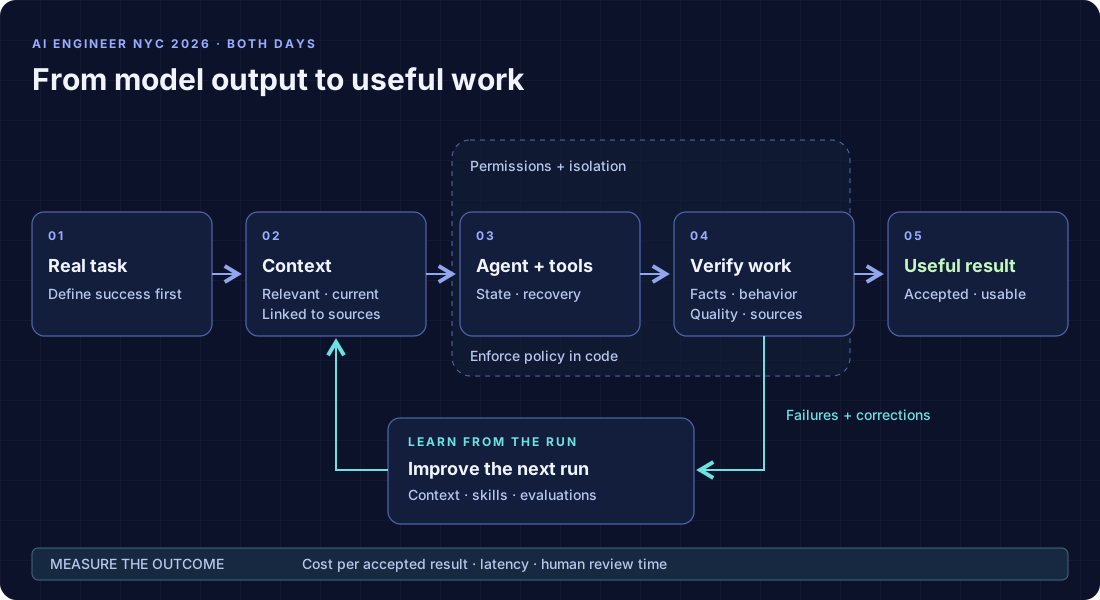
Define the task. Give the agent context and controlled tools. Verify the work, then use what you learn to improve the next run.
Day 1 · Oct 13
Agent systems, evaluation, and the foundations for putting AI to work.
24 session summaries
Day 2 · Oct 14
Trust, verification, compute economics, and what makes agent work valuable.
24 session summaries
Each guide compares approaches from both days, explains where the evidence stops, and suggests an experiment you can measure.
01 / Evaluation
Day 1 builds benchmarks from real tasks. Day 2 adds behavior specs and regression tests for decisions inside long agent runs.
02 / Agent systems
Connect traces, memory, triggers, and recovery. Then use that feedback to improve the model as well as its runtime context.
03 / Security
Pair task-scoped permissions with deterministic checks. Day 2 adds incident evidence for isolation, network limits, and short-lived identities.
04 / Compute economics
Start with Revolut’s serving results. Compare operator performance and understand how compute contracts affect access and cost.
05 / Workflows and trust
Keep approvals, execution rules, arithmetic, and source checks explicit. Compare typed plans, policy-driven loops, and verified citations.
06 / Company context
Day 1 tackles changing schemas and expert knowledge. Day 2 adds dated company facts and a shared gateway for tools, memory, and monitoring.
07 / Coding and product value
Connect code quality and product polish to delivery cost. Day 2 brings cost per merged pull request and accessibility requirements for coding agents.
08 / World models
Compare General Intuition’s action-labeled game data with Runway’s video simulation approach. Keep shipped demonstrations separate from future promises.
The official talk library ↗ has detailed reading editions, slides, and searchable transcripts for October 13. Our guides connect the engineering lessons across both days. Matching session notes link directly to the official editions.
Twelve actions drawn from both days. Follow the paired sessions to compare the evidence and trade-offs.
Build a test set from your own work. Start with real questions, past tasks, and known failures. Keep the examples as regression tests when you change models or agent context.
Check the decisions inside long agent runs. Define expected behavior before changing prompts or tools. Review traces against that spec and replay from the decision that went wrong.
Enforce permissions on every tool call. Use task-scoped access, explicit budgets, and checks outside the model. Bloomberg’s incidents extend Day 1’s authorization lesson to network access and tenant isolation.
Keep credentials and audit records outside the agent’s control. Use a proxy for approved access. Protect the rules the agent must follow, and remove credentials when the run ends.
Separate model judgment from execution rules. Use the model where interpretation is needed. Keep approvals, required gates, and failure handling in code. Increase autonomy only when repeated evaluations justify it.
Keep source facts separate from generated explanations. Adapt schemas to the task, but preserve source identifiers. Retrieve and calculate numbers with code. Refuse unsupported facts instead of relying on a final citation check.
Compare cost at the quality and latency you need. Measure useful output under your workload before buying capacity. Serving software and operator choices change what the same hardware delivers.
Test a smaller specialist before using a frontier model everywhere. Use task evaluations to route work. Day 1 shows why model rankings vary by task; Day 2 shows Ramp post-training a specialist beneath a frontier orchestrator.
Capture expert judgment and track when facts change. Have experts explain decisions when they write skills. Date the facts those skills use, preserve their history, and treat missing updates as missing evidence.
Turn production traces into the next improvement. Trace the agents building and running your system. Use failures and human feedback to curate evaluations. Test routing or training changes against those examples.
Measure delivered value, not code volume or token spend alone. Set a baseline for the workflow you want to improve. Track accepted work and total delivery cost. More generated code does not prove more useful output.
Give coding agents product requirements before they build. Specify save behavior, undo, keyboard access, and semantic HTML. Check the result in a running product. CAIS’s reported cost saving is one experiment, not a general benchmark.
Day 1 shows agents taking on whole workflows at Arca. Day 2 asks how those workflows earn trust: Coinbase ties autonomy to measured quality, and Basis checks behavior throughout the run. The shared lesson is to design the process, the checks, and the fallback together.
Arca · Day 1 · Coinbase · Day 2 · Basis · Day 2
Keycard and Two Sigma make the case for scoped actions and proportional review. Bloomberg’s Day 2 incidents show why prompts and a sandbox alone are insufficient. Identity, network access, and enforcement must remain outside the model’s discretion.
Keycard · Day 1 · Two Sigma · Day 1 · Bloomberg · Day 2
Revolut measures serving cost and latency. SemiAnalysis measures acceptable output from the same hardware. Jellyfish measures the full cost of a merged pull request. Together, they shift the question from cheap inputs to useful work delivered at the required quality.
Revolut · Day 1 · SemiAnalysis · Day 2 · Jellyfish · Day 2
Bridgewater builds a governed document corpus; Range captures planners’ judgment in skills. Citadel Securities adds a missing dimension on Day 2: facts become stale. Useful context needs dates, source evidence, and a way to revise beliefs without rewriting history.
Bridgewater · Day 1 · Range · Day 1 · Citadel Securities · Day 2
Arize turns telemetry into fixes. Ramp tests specialist models beneath its orchestrators. Prime Intellect proposes learning from the organization’s own traces and feedback. These are different stages of the same loop: observe failures, create tests, change the system, and measure again.
Arize AI · Day 1 · Ramp · Day 2 · Prime Intellect · Day 2
Both streams carried recorded talks during scheduled breaks. Start with these connections; the day digests link the rest.
Audit a tool call end to end. Compare Keycard’s permission demo with Intuit Credit Karma’s gateway, monitoring, and context optimizer.
Make agent-built products usable. Pair Railway’s product polish checklist with CAIS’s accessibility requirements for coding agents.
Test the less obvious security boundary. Day 1’s shared-GPU timing talk expands the threat model. Day 2’s Bloomberg talk brings concrete failures across tools, networks, and tenants.
Justify the next agent project. Compare Day 1’s workflow redesign argument with Day 2’s value case and cost-per-delivery research.
Sid Pednekar · Day 1 · Michele Grant · Day 2 · Jellyfish · Day 2
“It’s about how do you build the loop to write that feature.”
Aparna Dhinakaran, Arize AI · Day 1 · Session summary · Watch the moment
“The loop is really only as trustworthy as the check.”
Evan Kormos, Coinbase · Day 2 · Session summary · Watch the moment
“Skynet was, after all, a closed source company.”
Dillon Rolnick, Nous Research · Day 1 · Session summary · Watch the moment
“The reality is every fact has a half-life.”
Joao Wenzel, Citadel Securities · Day 2 · Session summary · Watch the moment